Motivation
- Data in the real world is dirty (not yet ready to be analyzed)
incomplete: missing values or interesting attributes, or largely aggregate datanoisy: containing errors or outliersinconsistent: containing discrepancies in codes or names
- Effective data cleaning is crucial because it directly impacts the accuracy and reliability of subsequent analyses and modeling.
- Data cleaning can consume a significant portion of a data scientist’s time, often ranging from 50% to 80% of the entire data analysis process.
- The time spent on data cleaning varies based on the dataset’s quality and complexity, with messier data requiring more effort.
- For small, clean datasets, data cleaning might take a few hours to a day, while for large and messy datasets, it can span weeks or even months.
- Automated tools & scripts can streamline data cleaning & reduce the time required.
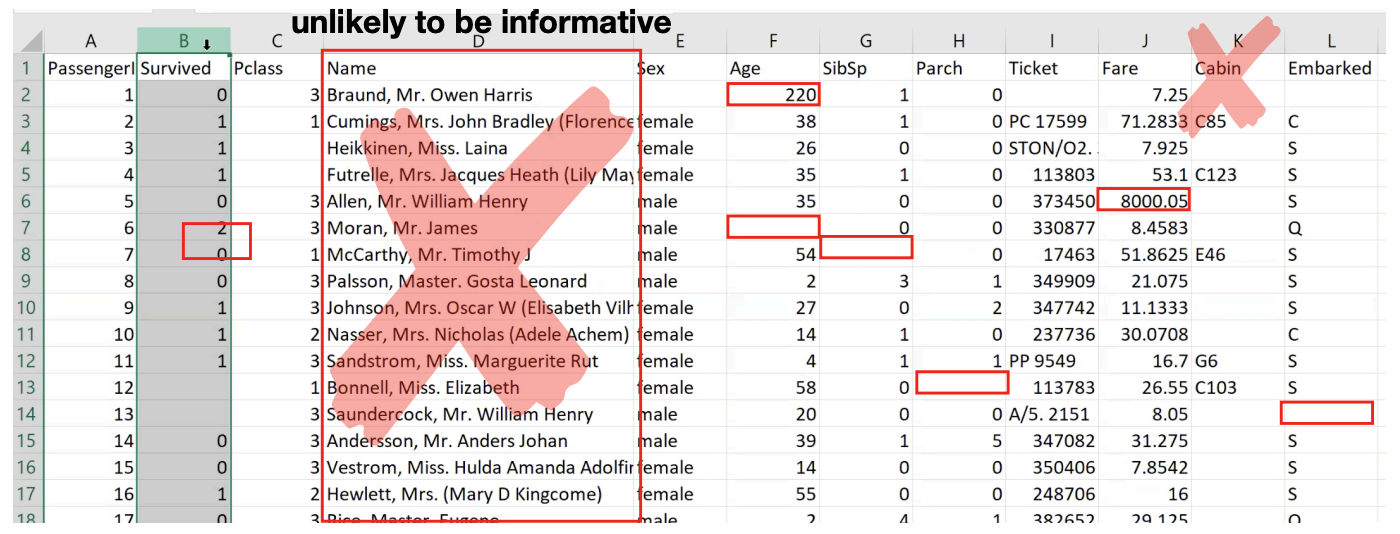
Motivating example:
- You should save as much USEFUL data as you can, and extract most useful features
- TO many missing values, in a column may mean it is unlikely to be informative
![]()
Causes of dirty data
Missing Values: Cells or fields with missing data.Duplicates: Duplicate rows or entries within the dataset.Inconsistent Formats: Variability in data formats (e.g., date formats, units of measurement).Outliers: Data points that significantly deviate from the norm.Incorrect Values: Data entries that are factually incorrect or implausible.Spelling and Typographical Errors: Misspelled or mistyped text data.Incomplete or Inaccurate Labels: Incorrect or incomplete variable or column labels.Irrelevant Information: Columns or variables that are not needed for the analysis.Inconsistent Casing: Mixed use of uppercase and lowercase characters in text data.Special Characters and Symbols: Non-standard characters or symbols that may need encoding.Inconsistent Encoding: Encoding issues, especially in international data.Data Entry Errors: Human errors during data entry.Inconsistent Units: Variations in units of measurement for numerical data.Inconsistent Date and Time Zones: Time zone discrepancies in timestamp data.Data Entry Conventions: Different conventions used for representing the same information.
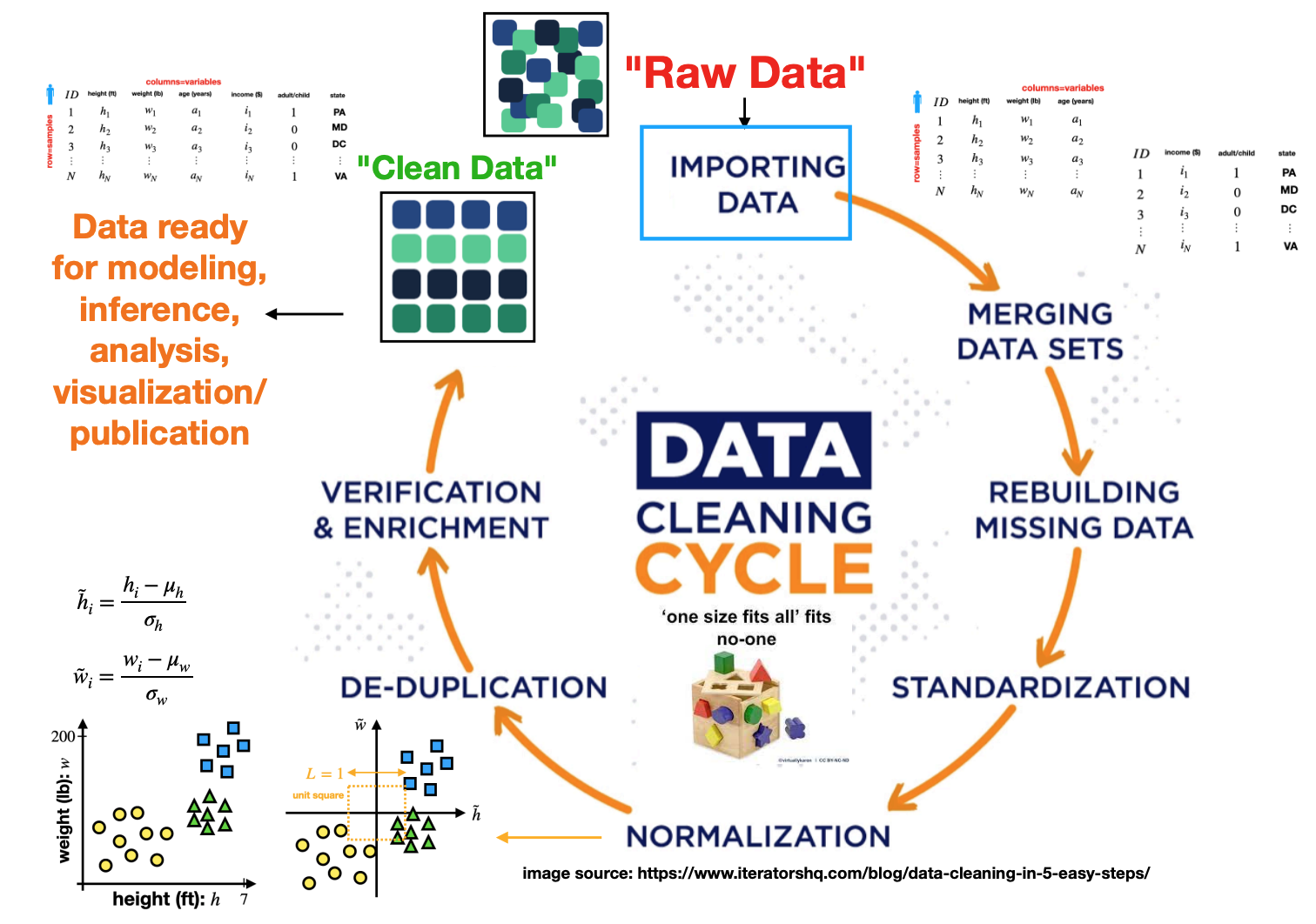
Data cleaning is an iterative process
- This is an over simplification: cleaning process is non-linear and task specific
![]()
Data Normalization
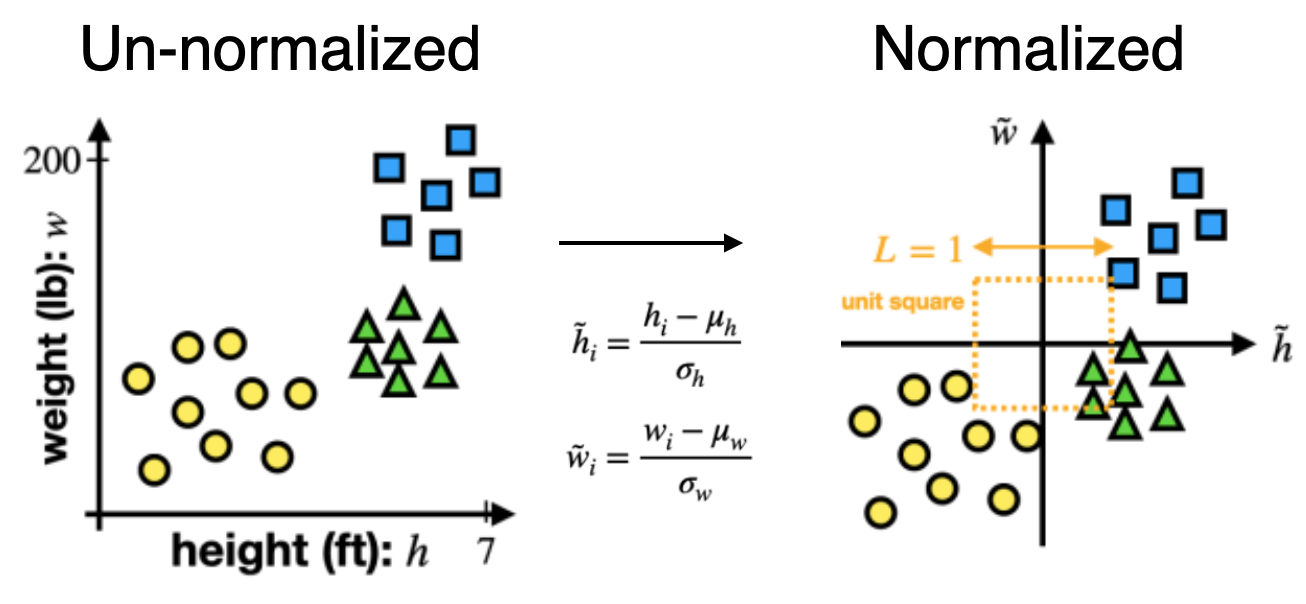
- Normalization is the process of scaling & standardizing numerical features or variables
- Normalization does not change the underlying distribution of the data but, ensures that features have a consistent scale for more accurate and stable modeling.
![]()
- Eliminates magnitude differences \(\rightarrow\) remap data to a common
scale, typically 0 to 1
- Normalization helps prevent certain features from dominating others in machine learning algorithms that rely on distance
More on this next week!