Waves
Trig-functions
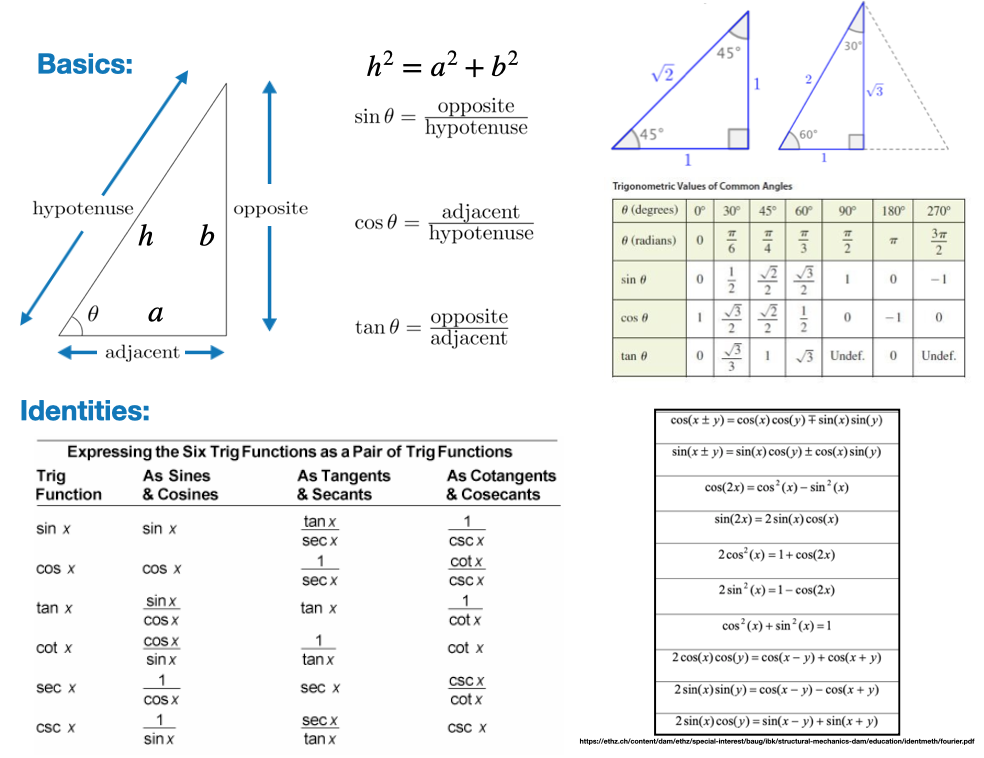
- Trig functions, particularly
sine&cosineare the corner stones of spectral analysis![]()
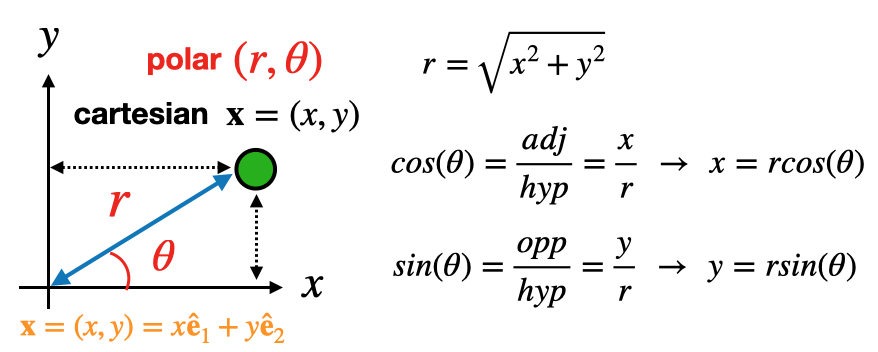
Polar coordinates
- Polar coordinates are important, because they connect the concepts of rectangular units, triangles, oscillations, rotations, imaginary numbers, angles, trig functions … etc.
![]()
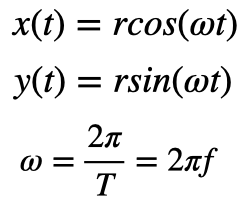
- Rotation: motion on a circle occurs when \(r(t) =r=\text{constant}\)
![]()
![]()

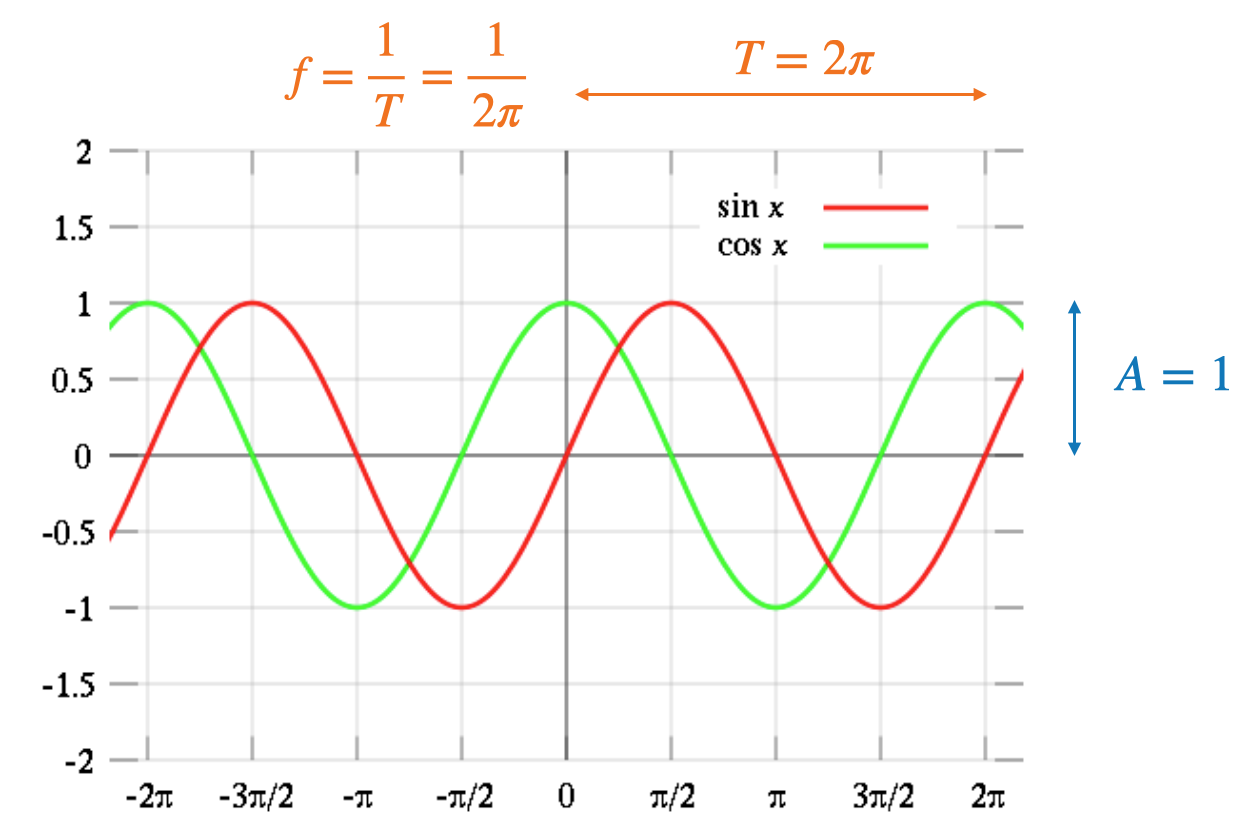
Sine vs Cosine
- Cosine and sine are the same function, but
out of phaseby a factor of \(\frac{\pi}{2}\)- \(\cos \left(t-\frac{\pi}{2}\right)=\sin (t)\)
Rotation
- The mathematics of oscillations are the same as for rotations. However, for rotation, there are two sinusoidal signals, one for x and one for y.
- Here we see the y-component of the position, however, the x-a follows a similar dependence
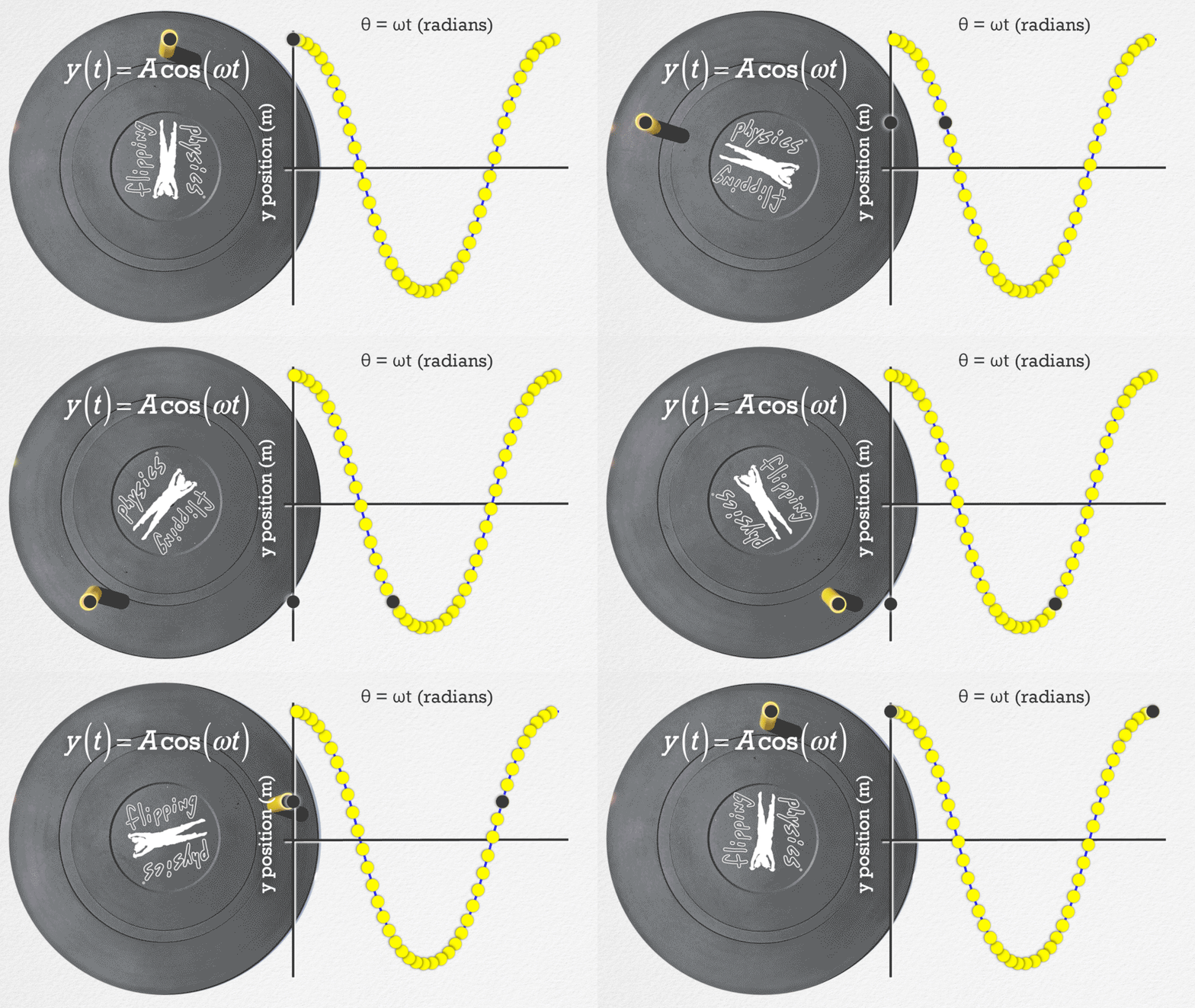
Harmonic motion
Sinusoidaloscillations are fundamental to spectral analysis & many natural phenomena (sound, thermal vibrations, quantum mechanics, electrical signals)- Our journey begins with the simple harmonic oscillator, which is arguably one of the most important models in physics
The vertical position as a function of time obeys a sinusoidal relationship 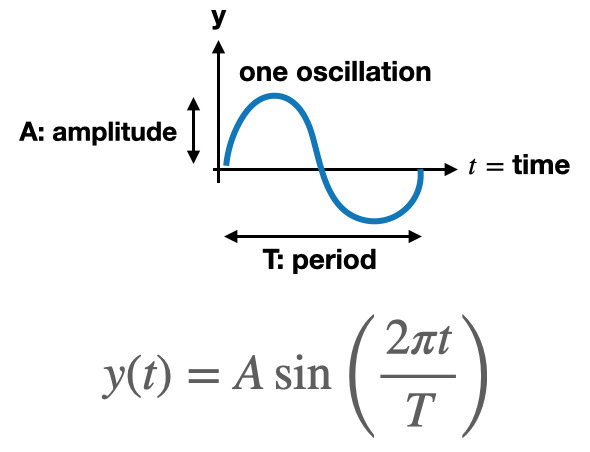

Fundamental components of a sine wave
- Before discussing the Fourier series, recall the components of the sine function.
- Having an intuition for these elements will help you understand the Fourier series
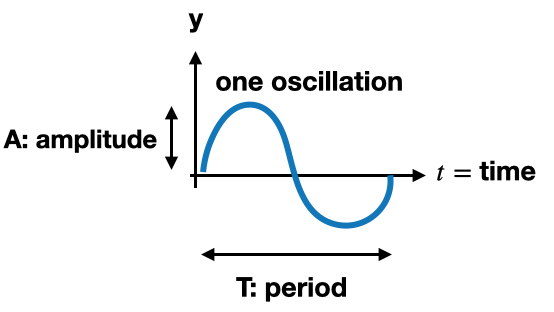
- \(t=\)
timevariable (time-units)- Generally, \(t\) can be any unit of time, for simplicity, lets consider seconds \((s)\)
- \(A=\)
Amplitude: Size of the perturbation (often units of length) - \(T=\)
period: time it takes for one oscillation (units of seconds) \((s)\) - \(f=\)
frequency: oscillations per second (units of Hertz, inverse seconds) \(s^{-1}\) - \(f=\frac{1}{T}\) frequency is the reciprocal of period
Unit conversion
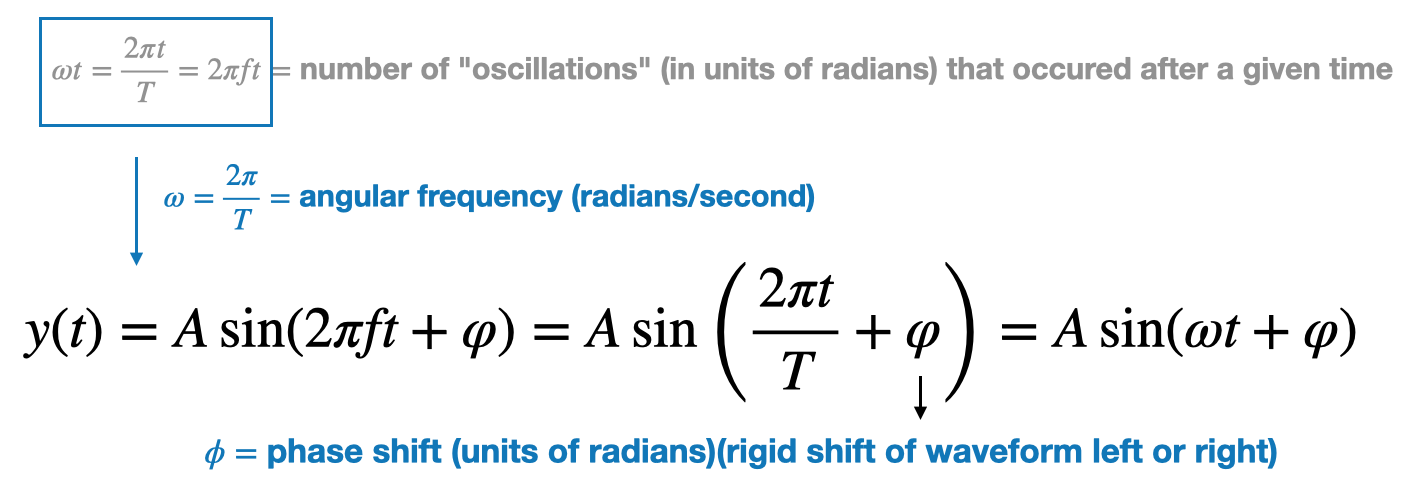
The input of \(\sin (x)\) or \(\cos (x)\) must have \(x\) in units of radians, so we need to convert units \[ \text{unit conversions:} \rightarrow \text{1 oscillation }=360^{o}=2\pi \text{ radians} \rightarrow \,\,1=2 \pi \frac{radians}{oscillation} \]
- \(\frac{t}{T}=1 \rightarrow 1\) oscillation occurred
- \(\frac{t}{T}=f t=\) number of “oscillations” that occurred after a given time \(t\)
- Convert oscillations to radians: \(\,\,\left(2 \pi\frac{\text { radians }}{\text { oscillation }}\right)\left(\frac{t}{T} \text{oscillation}\right)=\frac{2 \pi t}{T}\) radians
Function transformations
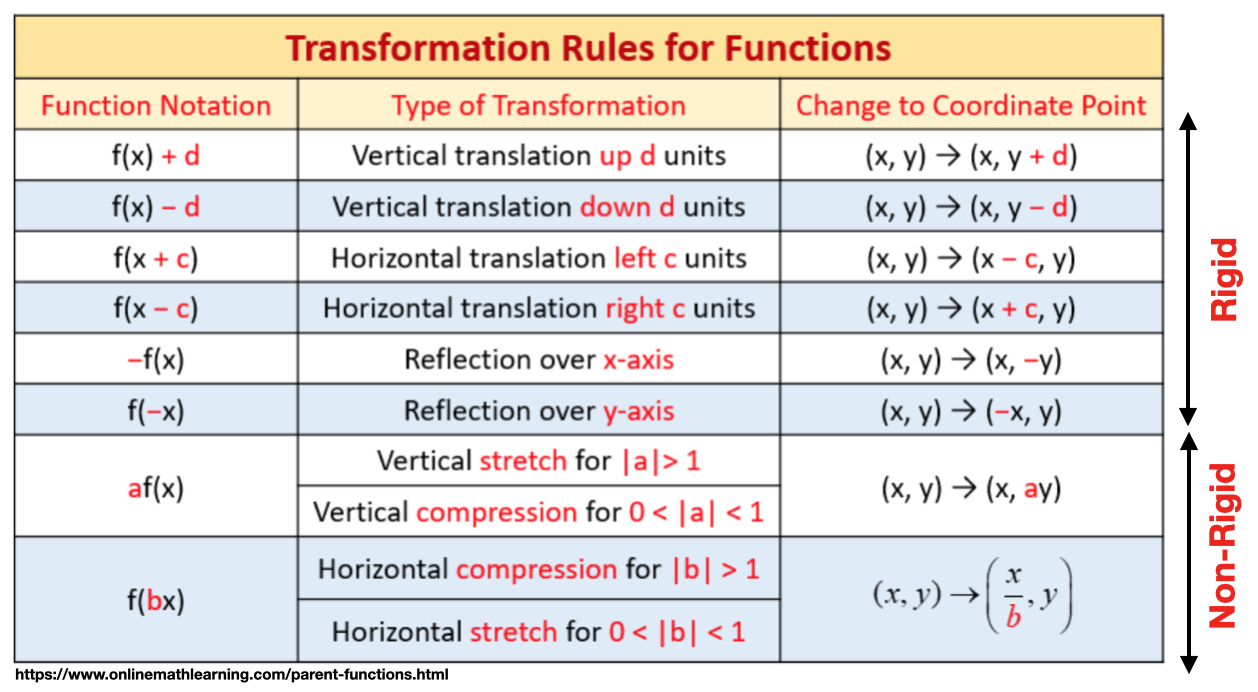
The following transforms can be applied to any single variable function
\(y=A f\left(\frac{t-t_o}{w}\right)+S\)
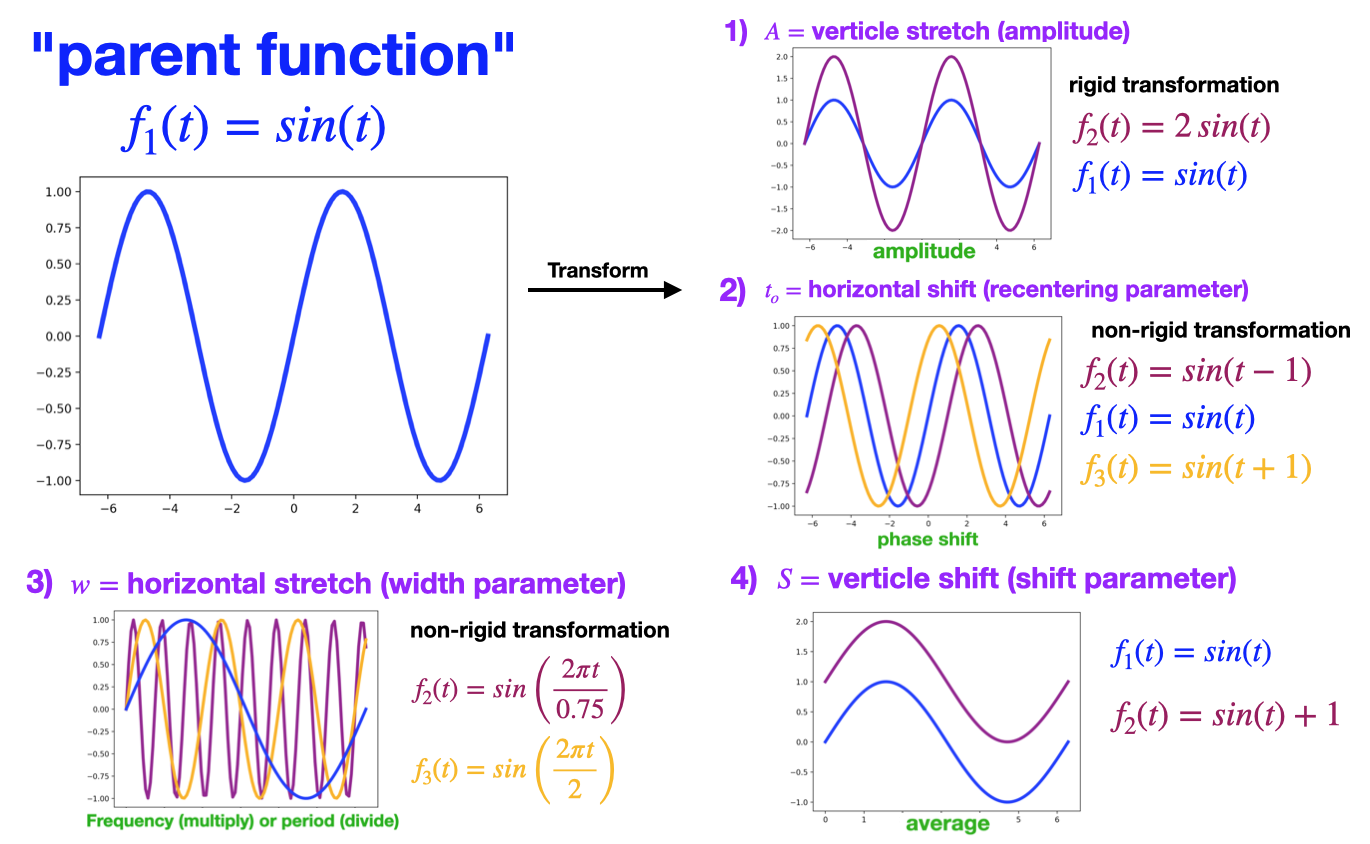
Sinusoidal transformations
We can apply these transforms to sin(x), in this case, the parameters get special names
Decaying oscillation
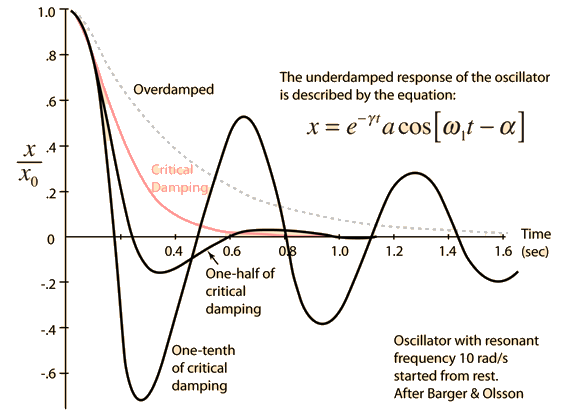
- With-out external resistance (i.e. friction), waves would oscillate forever, however generally they decay to nothing due to energy loss (heat).
- This means the wave is “dampened” by modulation of an exponential decay factor
Source: http://hyperphysics.phy-astr.gsu.edu/hbase/oscda.html
Wave packets
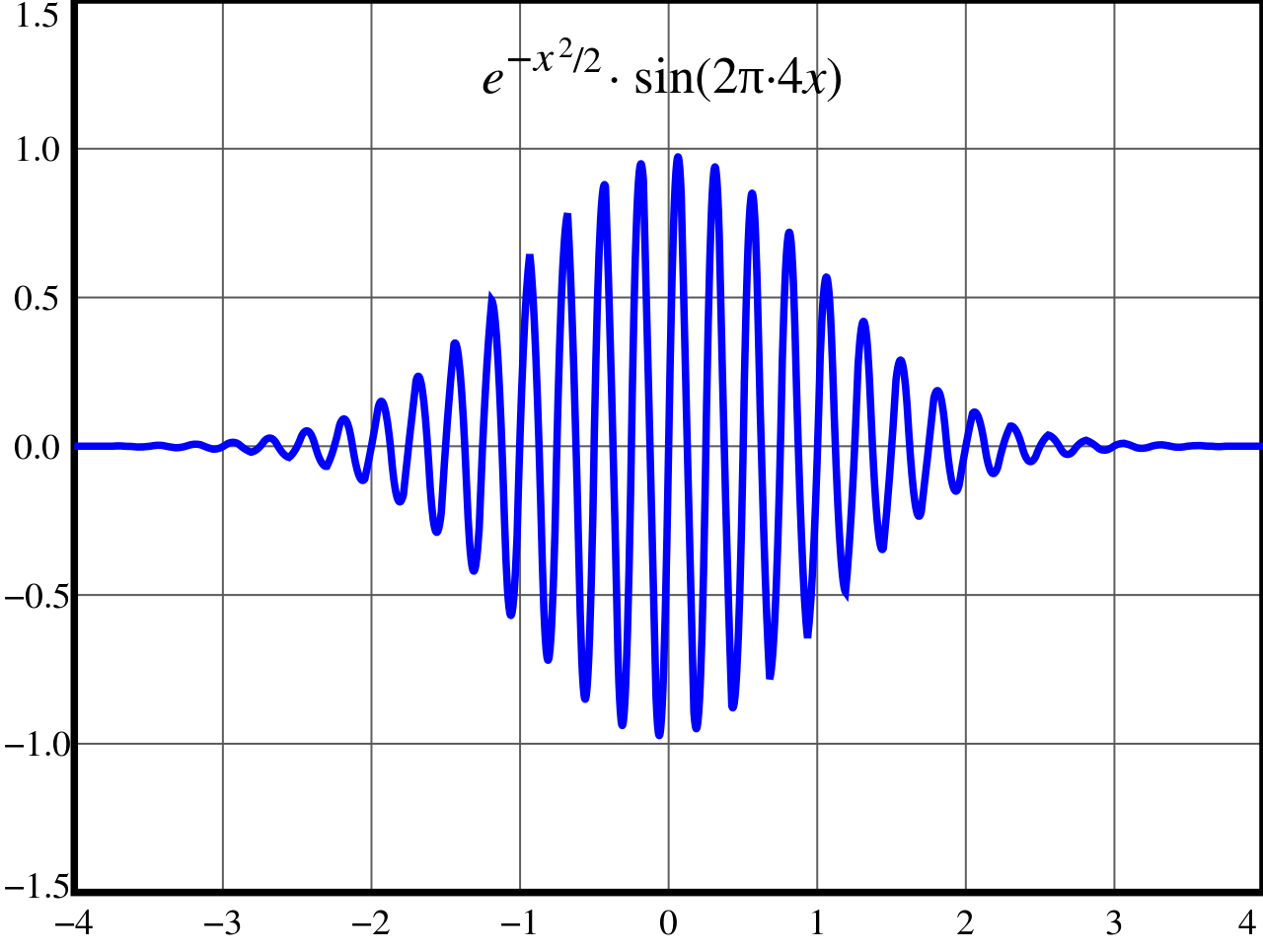
- A wave packet is a localized wave phenomenon that consists of a group of waves with a specific frequency spectrum and spatial extent.
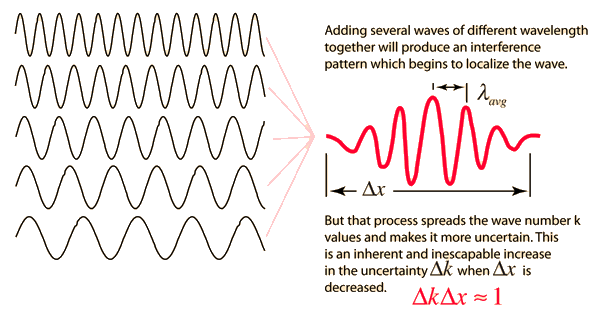 Source: http://hyperphysics.phy-astr.gsu.edu/hbase/Waves/wpack.html
Gaussian function modulating a single frequency (monochromatic) wave