Dynamic network models
Overview of common dynamic network models
Model-1: Linear threshold model
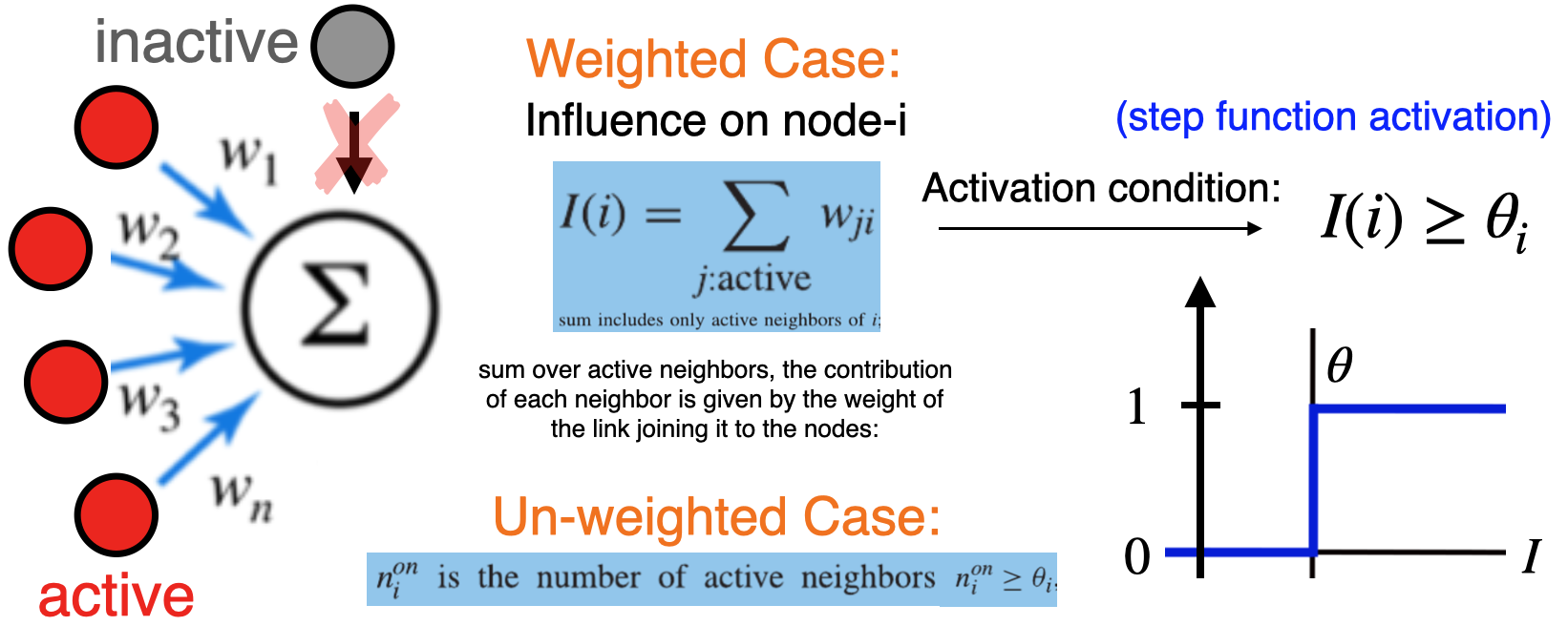
- Threshold models are based on the concept of peer pressure, i.e. nodes become
activatedbased on the influence of neighbors- In this case,
activeis a binary attribute of the nodes (e.g. sick or not sick)
- In this case,
- A node can be activated only if the influence exerted on it by its active neighbor’s exceeds some threshold value (hyper-parameter).
Source: Menczer1
Example: Fractional threshold model
- Example: The activation threshold is \(1 / 2\) for all nodes.
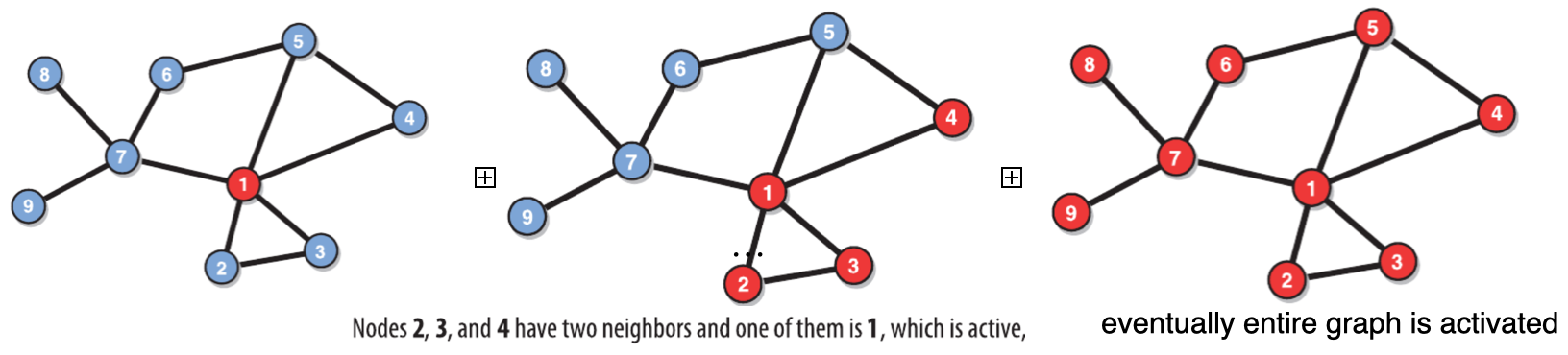
- key drivers of the process are the vulnerable nodes (i.e. those which can be activated by a single active neighbor).
Source: Menczer1
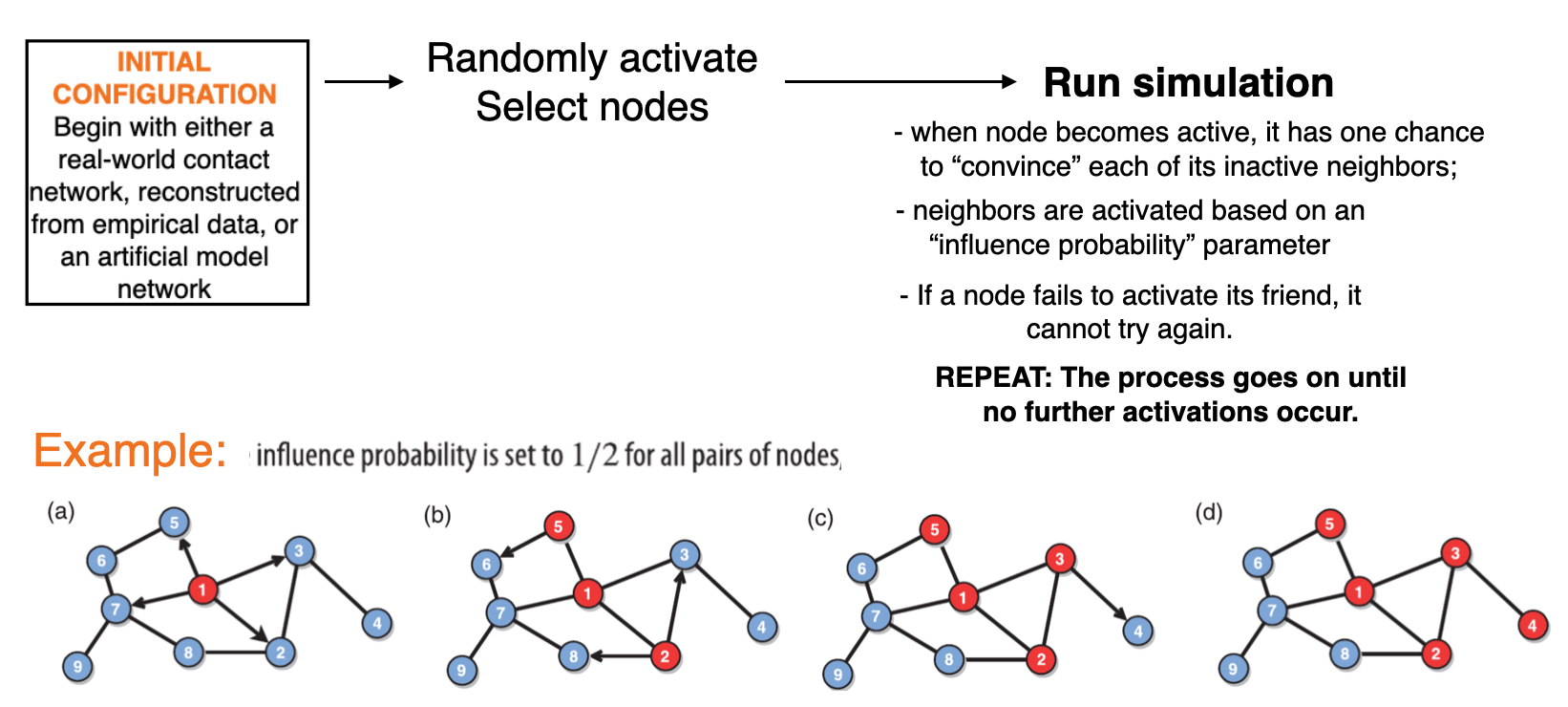
Model-3: independent cascade model
- General idea: The input of “friends” or other individuals is often more important than peer-pressure from random neighbors. Therefore, social influence is often one-to-one, rather than many-to-one.
- Because of this, Independent cascade models focus on node-node interactions.
Introduction
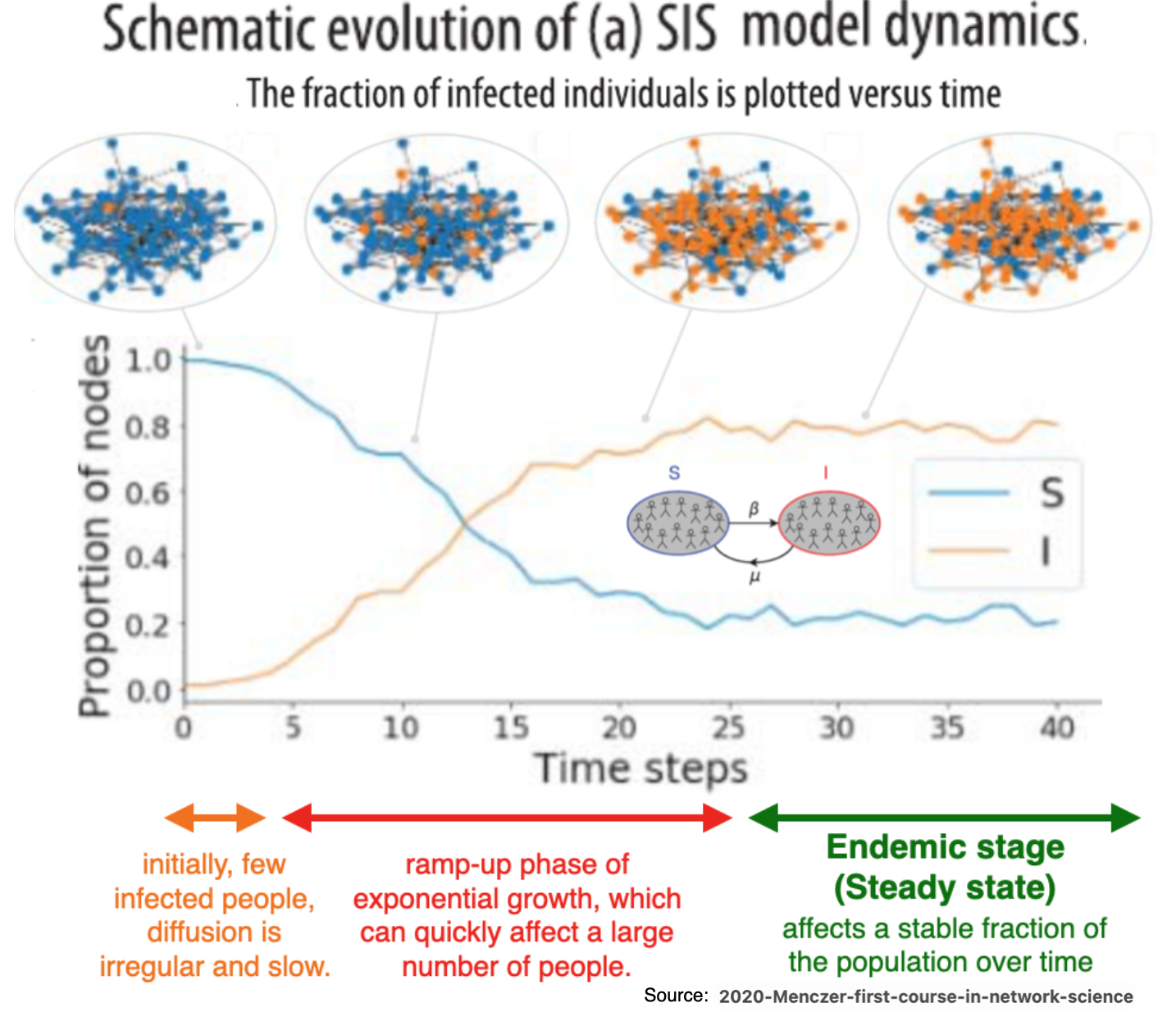
Model-4: (SIS) model
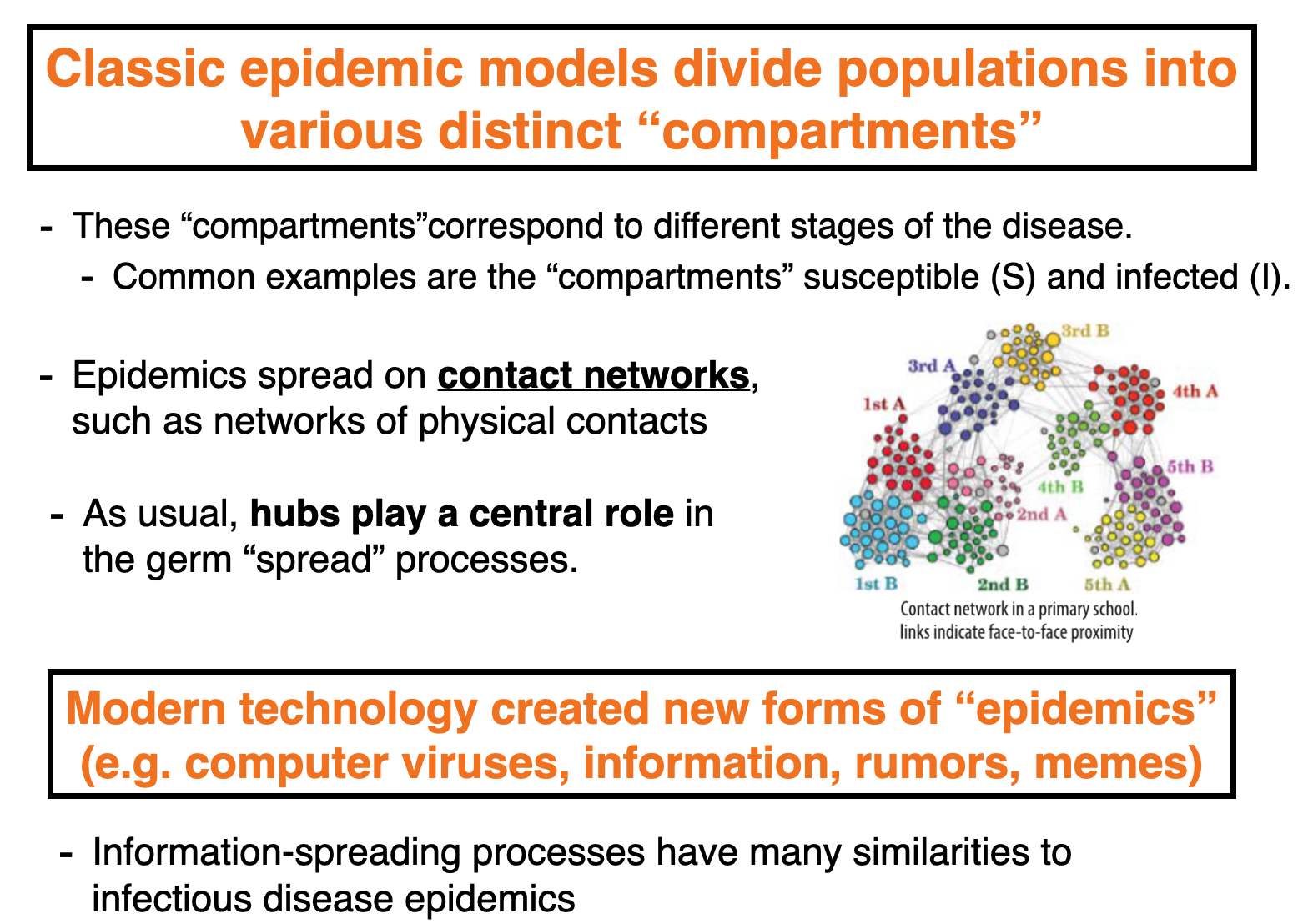
- Susceptible-infected-susceptible (SIS) model
- Infected individuals become susceptible again after recovery
- Applies to diseases without long-lasting immunity (e.g. common cold)
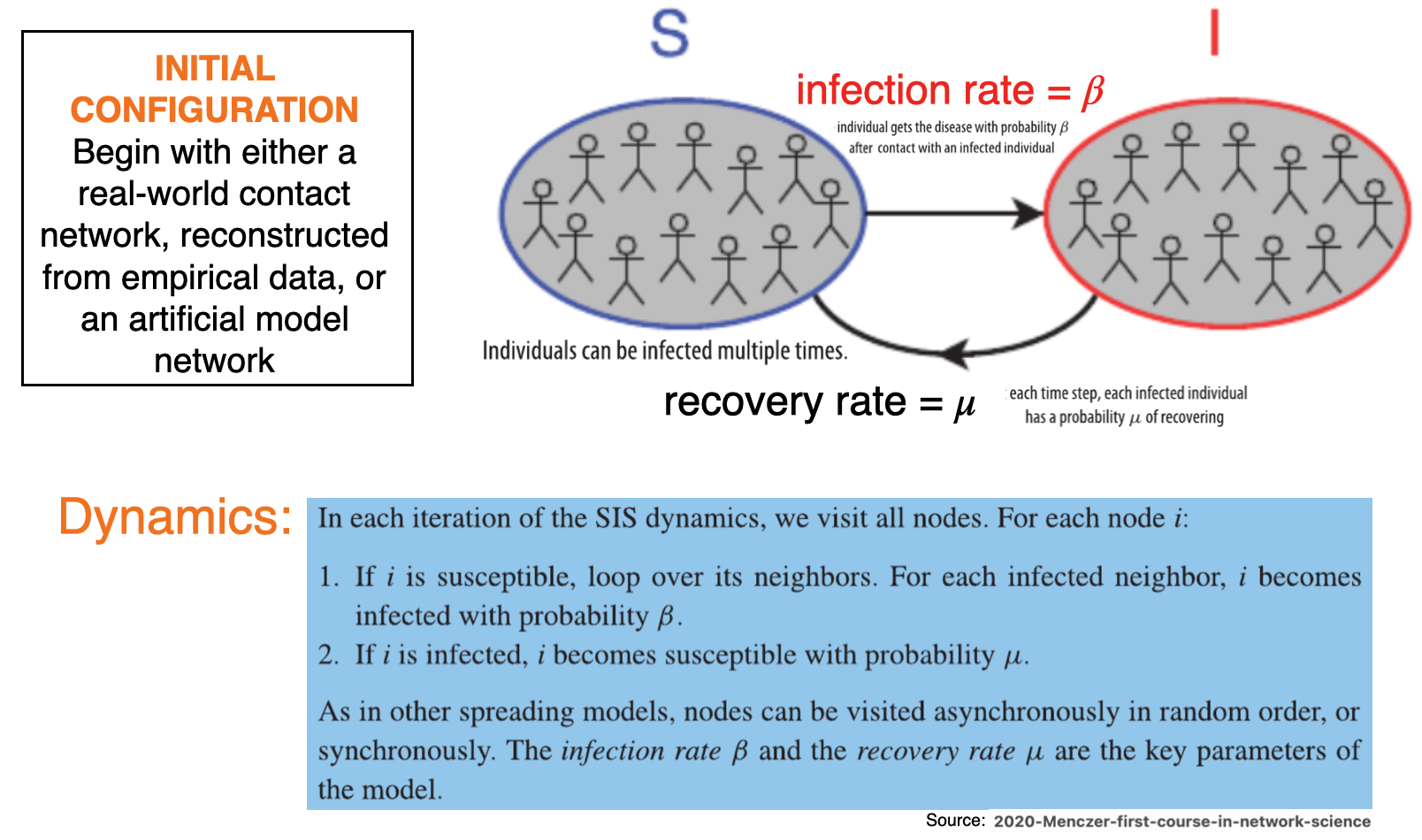
Example
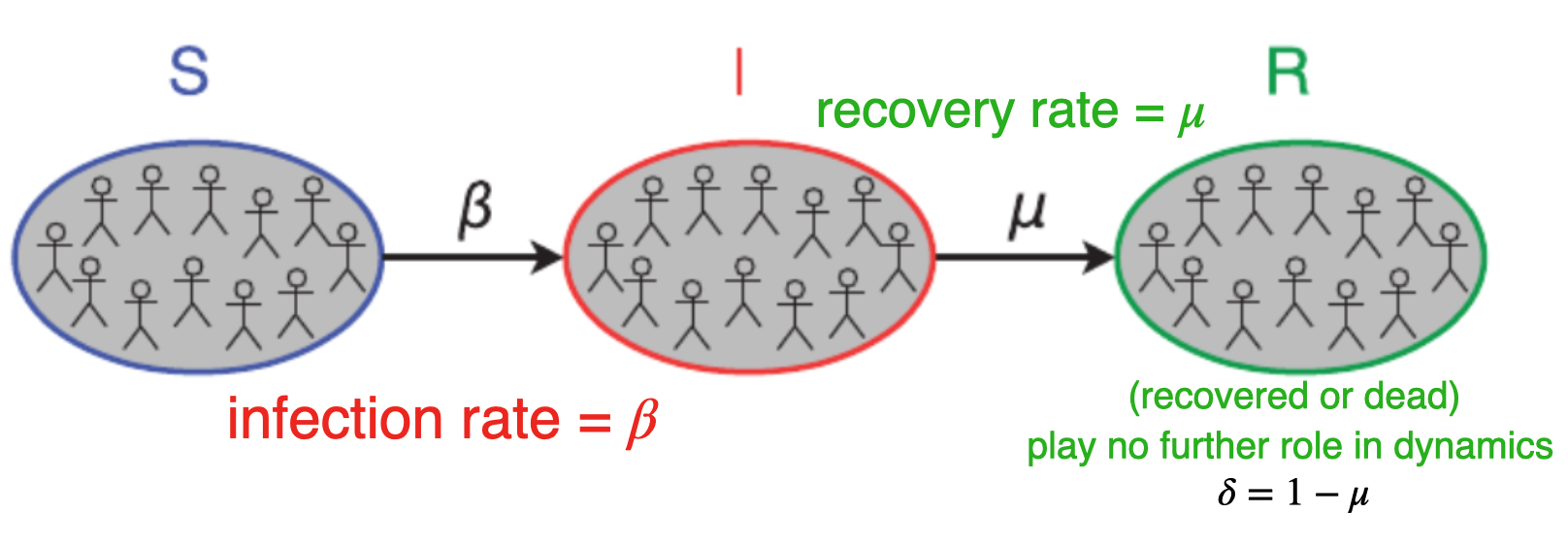
Model-5: Susceptible-infected-recovered (SIR) model.
- Infected individuals recover, and move to a third compartment, recovered (R), where individuals cannot be infected anymore
- Applies to diseases WITH long-lasting immunity (e.g. measles, mumps, rubella)
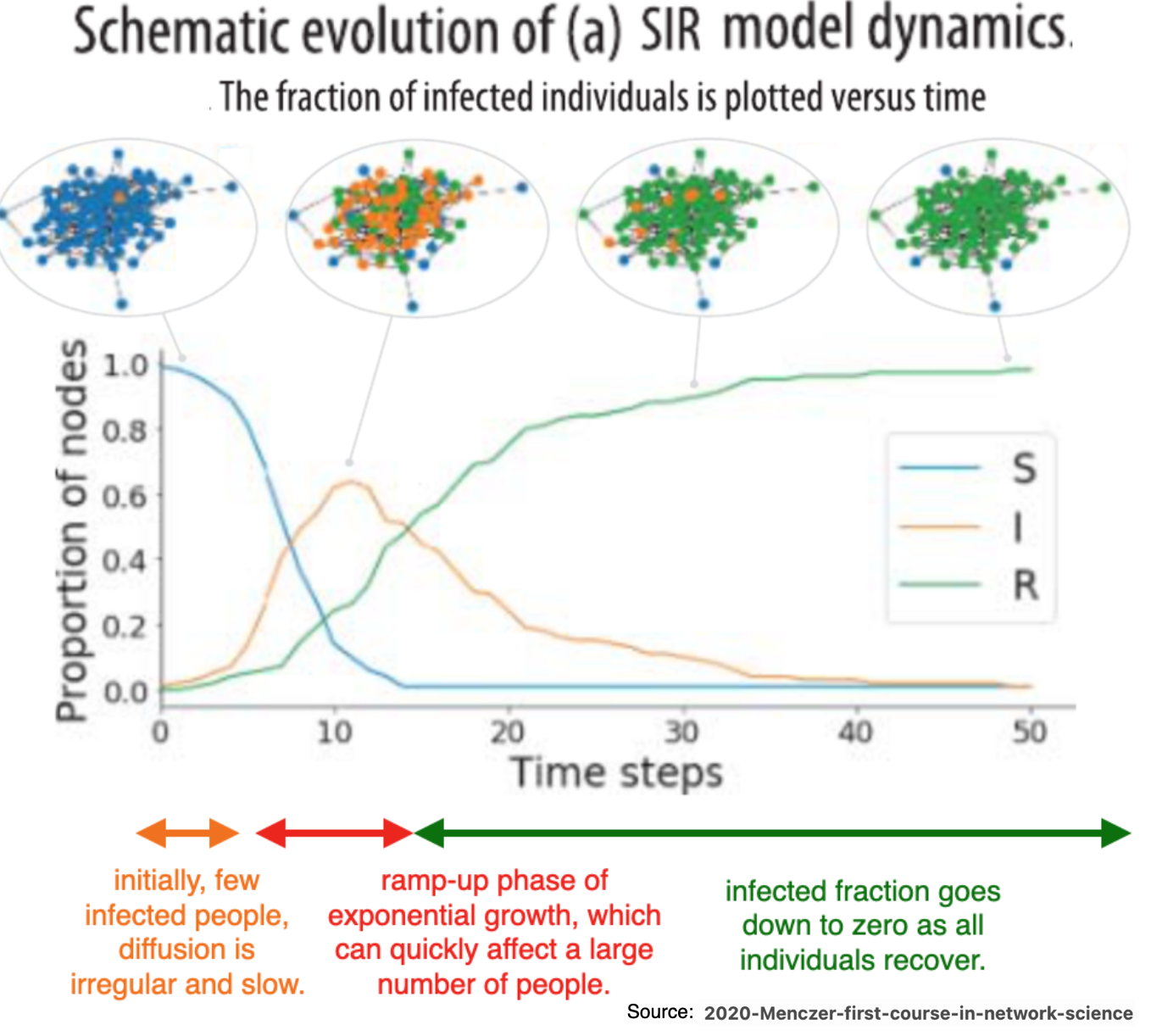
- The dynamics of infection and recovery follow closely those of the SIS model
- Eventually, the SIR model spreading stops, when there are no more infected individuals.
Example: SIR model
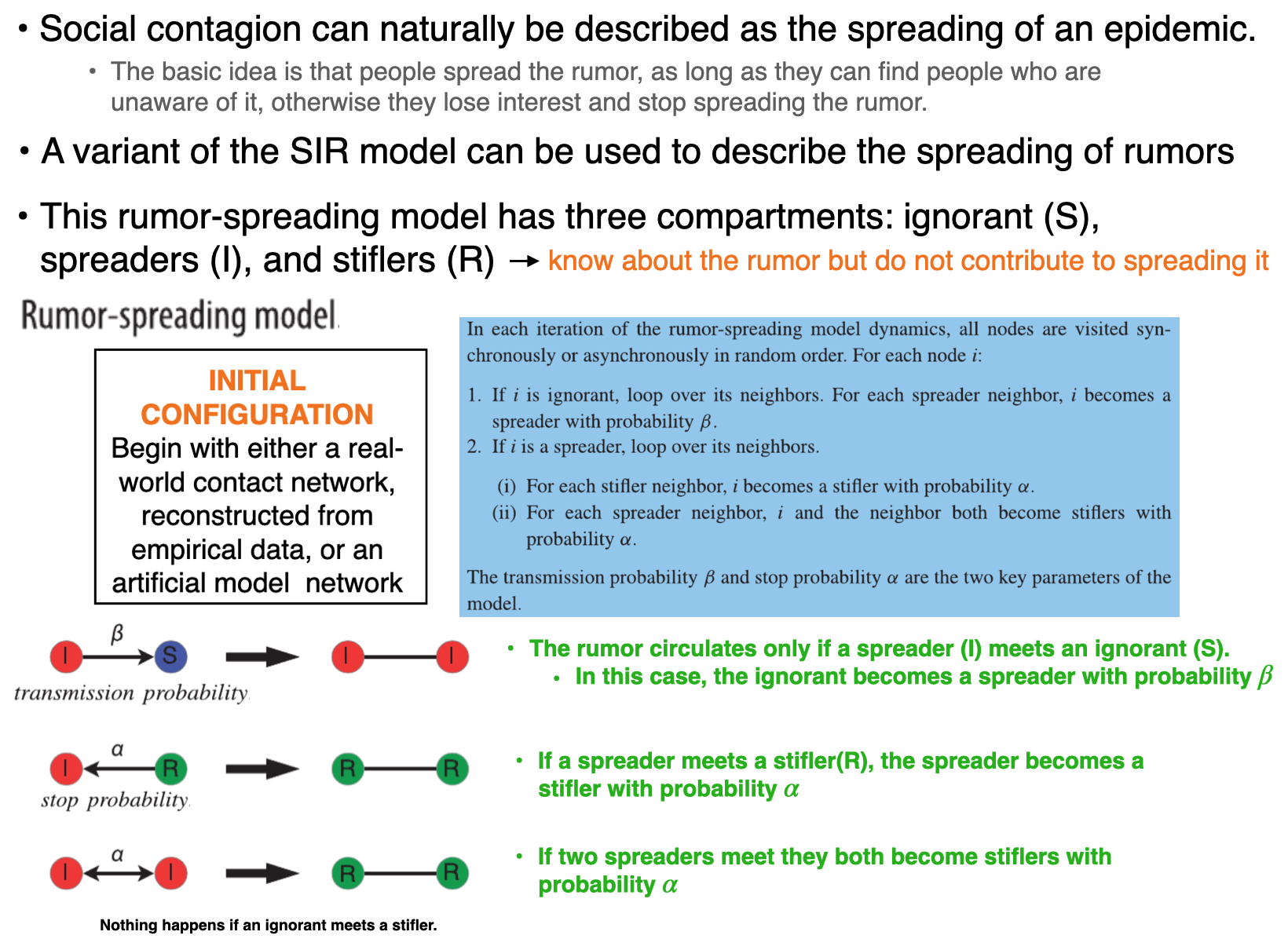
Rumor Spreading
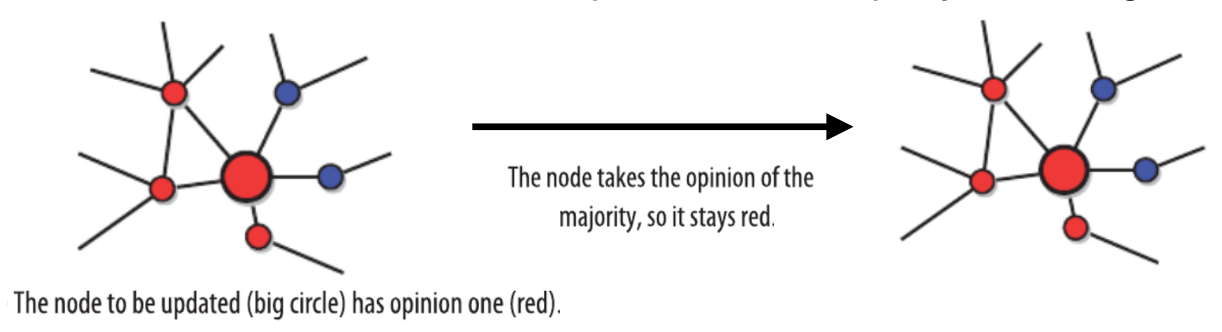
Majority model
- The dynamics are based on a majority rule: i.e. each node takes the opinion of the majority of its neighbors
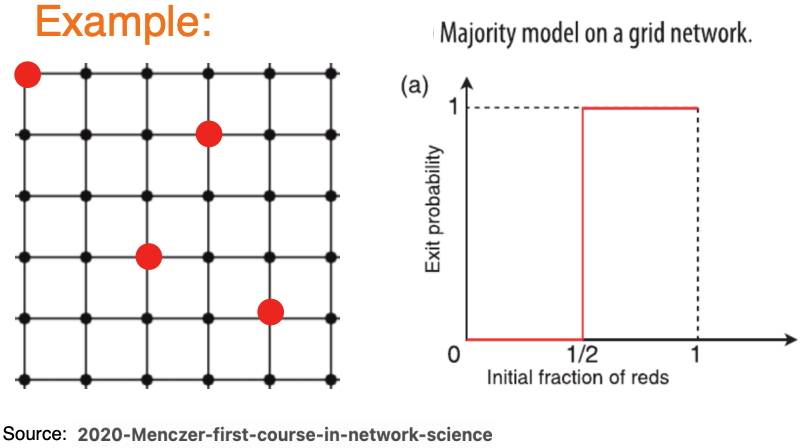
- Resolving ties: If the number of neighbors is even and there is an equal number with either opinion, then flip a coin to decide which opinion wins
Majority model: dynamic behavior
- In order to reach consensus on any opinion, that opinion must have the majority in the initial configuration.
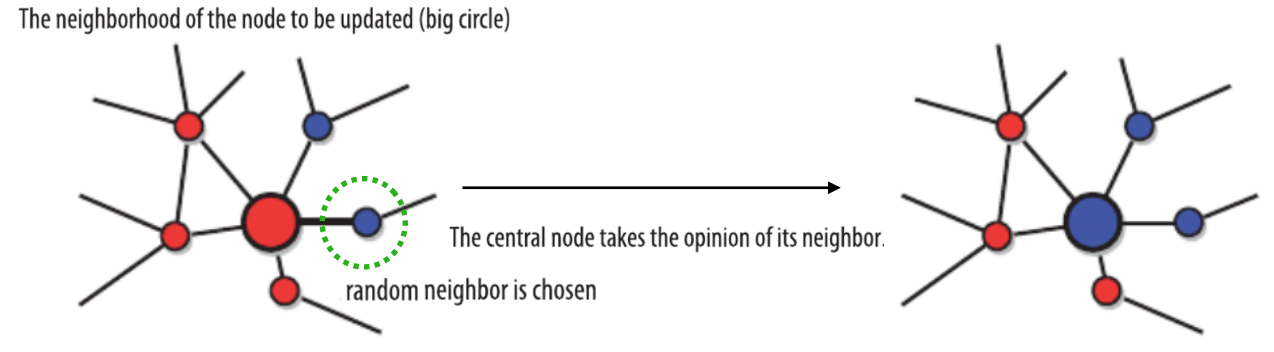
Voter model
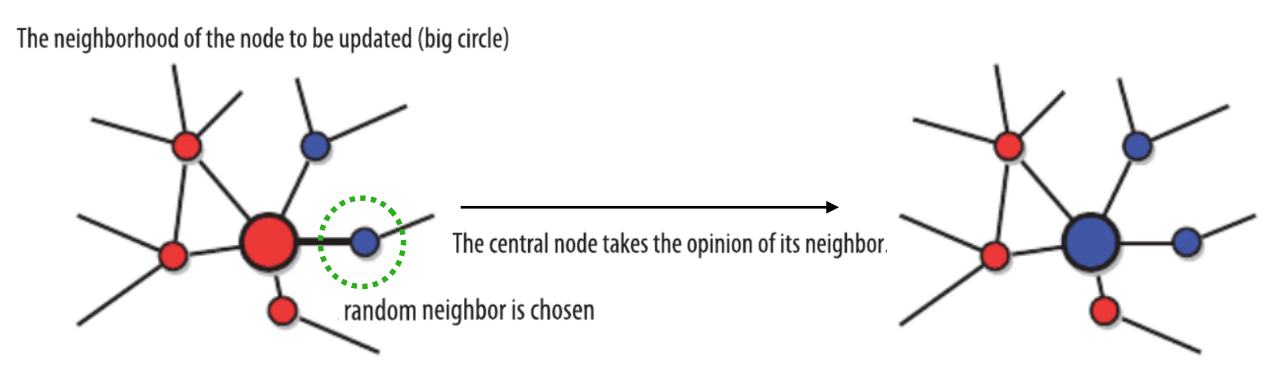
- Each node takes the opinion of a randomly chosen neighbor, whatever it may be.
- Consensus is the only stable state of the voter model dynamics, so it is the inevitable final configuration of the system
Voter model: dynamic behavior
- The outcome of the dynamics is uncertain
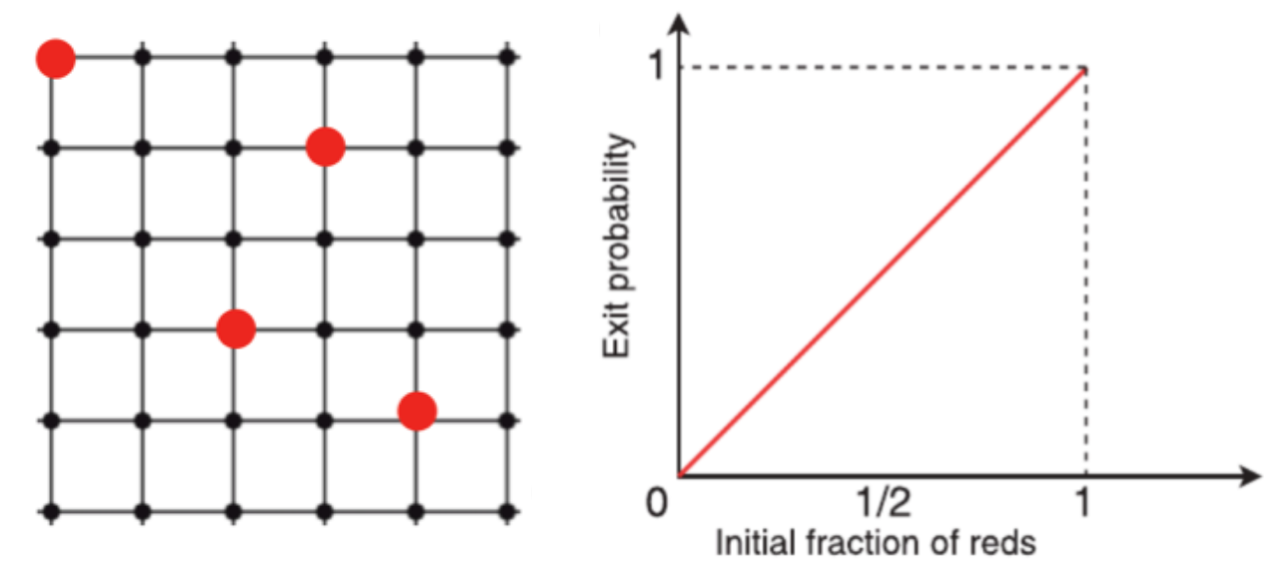
- The exit probability of the voter model coincides with the fraction of initial nodes with opinion one.
- The diagonal function indicates that the initial proportion of opinions one is also the probability of reaching consensus on opinion one.
Variants of the voter model
- The presence of zealots, nodes who never change their opinion. If they all have the same opinion, they will favor consensus around that opinion, otherwise consensus is never reached.
- Considering more than two opinion states. In this case, the interactions may be constrained to occur only among nodes with sufficiently close opinions. For example one could have three opinions \((1,2\), and 3 ) such that only neighboring opinions can interact (1 and 2, 2 and 3, but not 1 and 3). We discuss such a principle in detail in Section 7.3.2. Non-consensus configurations with non-interacting opinions are stable in any network.
- The possibility for nodes to change their opinion spontaneously, for example with a certain probability at each iteration, on top of the voter dynamics.
Coevolution of network structure and dynamics
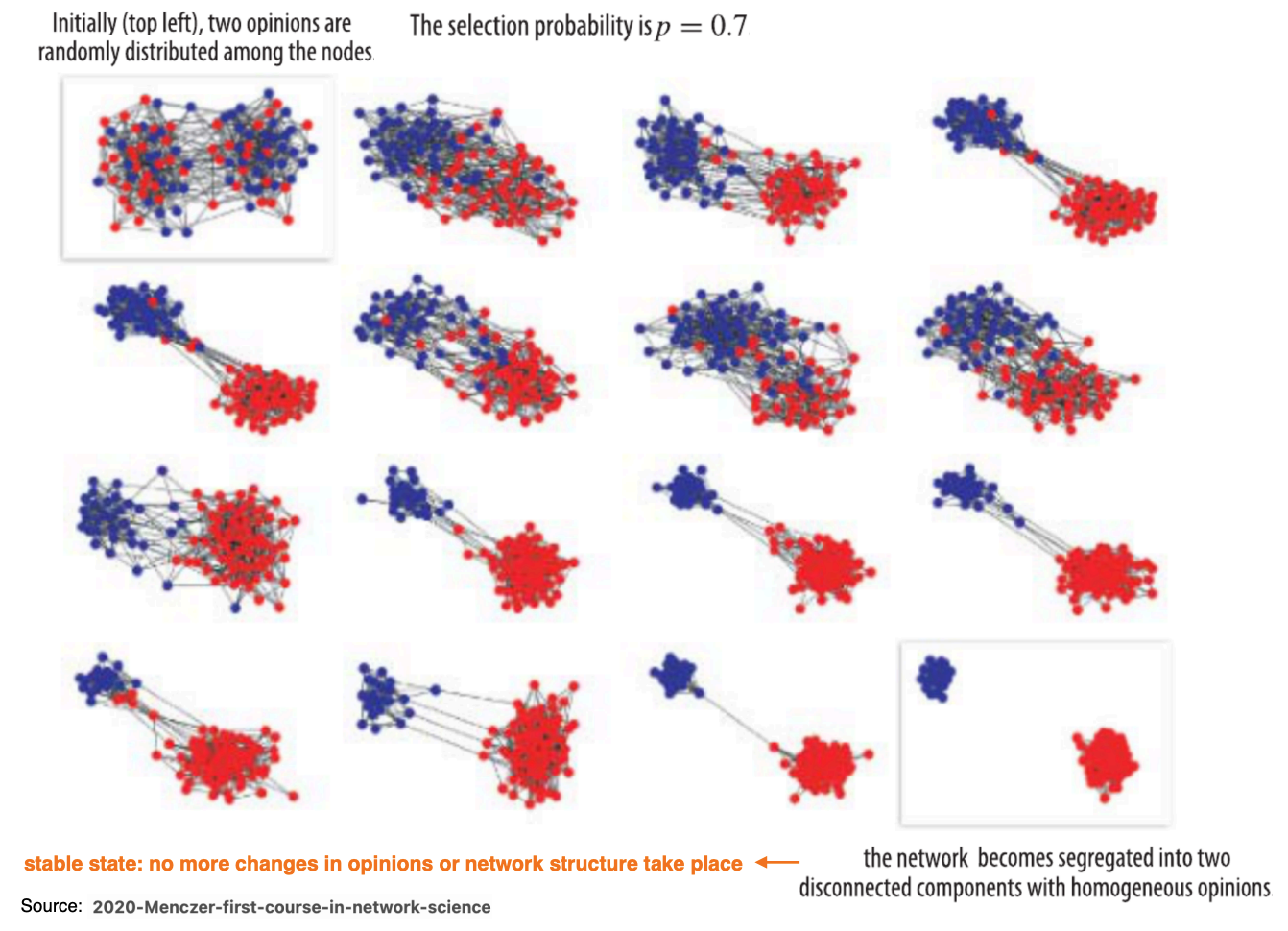
- At the beginning, opinions are randomly assigned to the nodes.
Algorithm
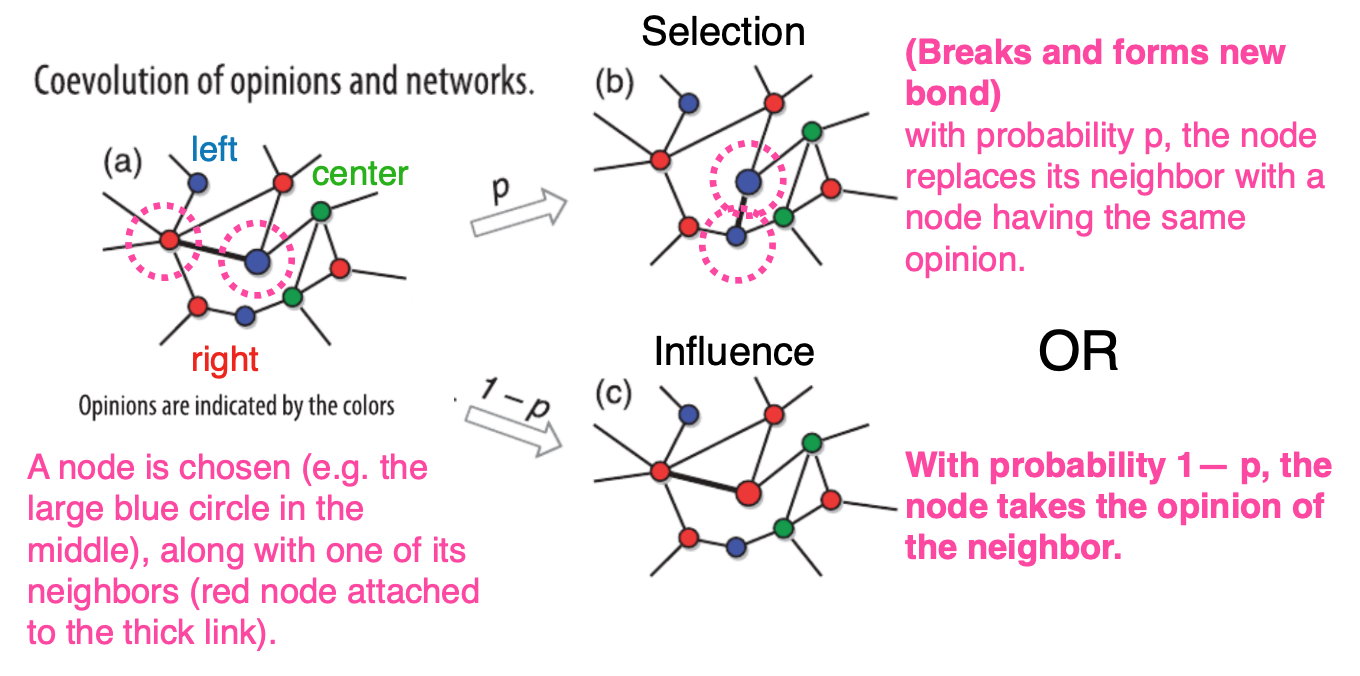
- Each iteration of the coevolution model requires a sweep over the nodes, synchronously or in random order. When we examine node \(i\), we select a random neighbor \(j\) with different opinion from \(i\) :
- With probability \(p\), the link between \(i\) and \(j\) is rewired from \(i\) to a randomly selected non-neighbor holding the same opinion as \(i\) (selection).
- Else (with probability \(1-p\) ), \(i\) takes the opinion of \(j\) (influence).
- The selection probability \(p\) is the single parameter of the model.
Coevolution model dynamics
Summary (BCM)
Social diffusion mechanisms